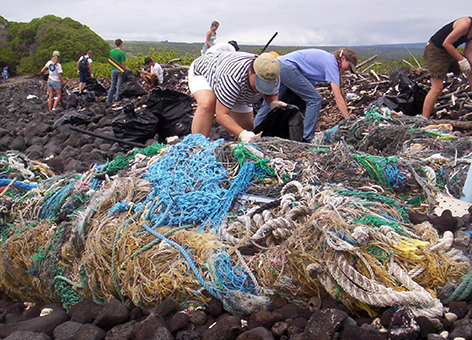
Plastic leakage is often discussed as a moral failing. But the most actionable way to read it in 2026 is as a balance-sheet problem for the ocean economy — one that now comes with unusually crisp datapoints from the World Bank and NOAA.
The World Bank says food from the ocean — fisheries to aquaculture — "nourishes over three billion people" and that fisheries and aquaculture "employ an estimated 62 million people worldwide in primary production" (World Bank). When plastic clogs a river, when ghost gear keeps fishing after it is lost, and when microplastics become a compliance and reputational issue for brands, the costs are no longer confined to the beach cleanup line item.
For policymakers, one number matters because it is investable: the World Bank notes that as of July 2025, its solid-waste-management commitments from active operations were "$2.8 billion" (World Bank). The Bank frames that spending as part of a "full value-chain approach" that aims to prevent leakage and push plastic systems toward circular-economy economics rather than a linear "make, use, dump" model (World Bank).
Removal is measurable — and still expensive
Downstream removal remains essential, but it is not glamorous, and it is rarely cheap. NOAA’s Marine Debris Program says it is the "United States Government’s lead for addressing the impacts of marine debris on our ocean, waterways, and Great Lakes" (NOAA Office of Response and Restoration).
"Prevention is the ultimate solution to marine debris." — NOAA Marine Debris Program, Office of Response and Restoration
Even so, NOAA also publishes hard output metrics: since 2006, it says it has supported "over 260" marine debris removal projects and removed "more than 83 million pounds" of debris from coasts, ocean, and the Great Lakes (NOAA Office of Response and Restoration). Read those numbers two ways: they show capability — but also the scale of what is already loose in the system.
Science-to-policy is accelerating
What changes the conversation is the speed at which ocean science can now map problems — and therefore change incentives upstream. UNESCO’s Ocean Decade exists, in the words of UN Special Envoy Peter Thomson, "to give us the solid science we need to make sound decisions in the future" (UNESCO). UNESCO adds that its Intergovernmental Oceanographic Commission (IOC), as the Decade’s lead agency, is "leveraging a global network of experts, scientists, and partners to generate ocean knowledge" (UNESCO).
On the exploration edge, OceanX is helping expand what that "solid science" can look like in practice. A July 8 update from Harvey Mudd College describes biologist Cathy McFadden joining an OceanX expedition off Palau aboard the OceanXplorer, where teams used tools including remotely operated vehicles and environmental DNA sampling to run a deep-sea biodiversity "bioblitz" (Harvey Mudd College). "The ultimate goal of these kinds of expeditions is to document as many species as possible while we still can," McFadden said (Harvey Mudd College).
Data does not pick winners on its own. But it makes trade-offs explicit — and that is when capital and regulation can start to line up. When a development lender is already writing multi-billion-dollar cheques for waste systems, when a federal program can quantify 83 million pounds removed, and when global ocean science is being coordinated under a decade-long framework, the missing piece is often execution across cities, ports, and supply chains.
OceanVines exists "to illuminate the inner sparks of every life we touch through our efforts in ocean conservation and education." The most durable plastic solutions are the ones that reach people early — not only through laws and infrastructure, but through literacy: what enters a storm drain, what a river carries, and how the ocean returns the bill.
What to watch next
For investors and policymakers in Asia, the signal is not a new “garbage patch” photo. It is whether leakage indicators and cleanup liabilities begin to show up in procurement rules, extended producer responsibility enforcement, and port-state controls on fishing gear. The next step is to make prevention cheaper than cleanup — and to make cleanup measurable enough that it can be financed when prevention fails.
Together, we celebrate The Greatest Good.