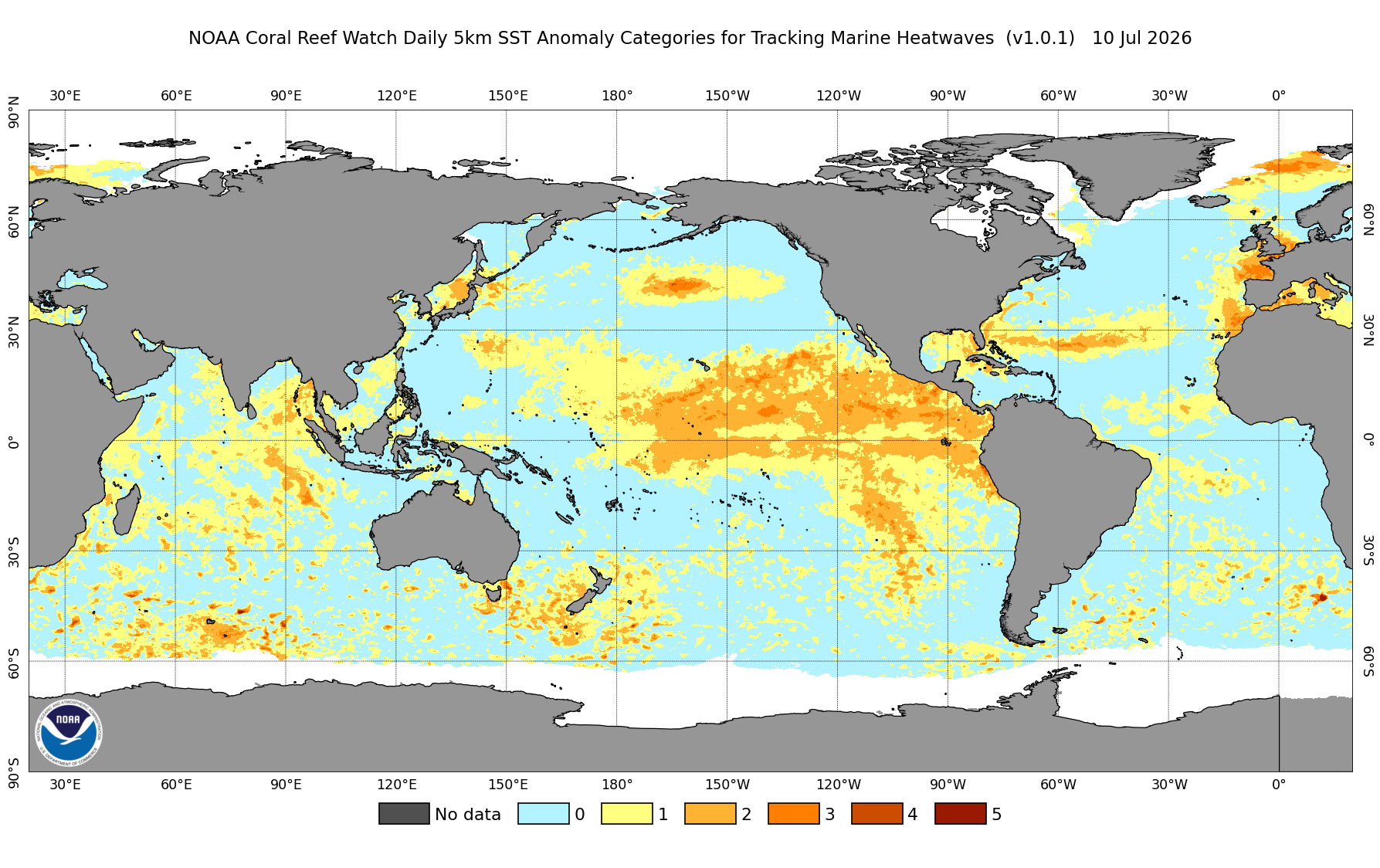
Marine heatwaves—stretches of unusually warm ocean water that can persist for weeks to months—are intensifying across several basins, according to the latest weekly bulletin from Mercator Ocean International and monitoring updates from NOAA’s Physical Sciences Laboratory.
The near-term stakes are not academic. When surface waters warm, productivity can drop, harmful algal blooms can become more likely, and fisheries and coastal tourism can take a hit—turning what looks like a climate chart into a balance-sheet problem for communities that depend on the sea.
Where the heat is concentrating
In its 4 July bulletin, Mercator Ocean said a marine heatwave off the coasts of Florida and Cuba is intensifying, while another around the Philippines is strengthening and a separate event is developing east of the Philippines. Mercator’s note also flagged a developing marine heatwave south of Alaska and changing conditions across the Mediterranean.
NOAA’s Physical Sciences Laboratory, which publishes a monthly global forecast discussion, reported that in May 2026, 28% of the global ocean experienced marine heatwaves (18% when the long-term warming trend is removed), and that marine heatwaves were present in regions including the Kuroshio Extension and parts of the eastern Pacific. The same update said global marine-heatwave coverage is predicted to exceed 40% (30% detrended) by boreal winter 2025–2026. (See the NOAA PSL marine heatwaves page.)
Impacts: fisheries, algal blooms, and reef stress
For resource managers, the challenge is that marine heatwaves do not just warm the water—they can reorganize ecosystems. In a NOAA Fisheries feature on prolonged warm conditions along the U.S. West Coast, Andrew Leising, a research oceanographer at NOAA’s Southwest Fisheries Science Center, said: “We have forecast tools that provide some insight, but we are also watching carefully for implications on the marine ecosystem.” (NOAA Fisheries)
Leising also underscored the uncertainty scientists are grappling with when warm-water patterns diverge from expectations: “We’re in La Niña, but water temperatures along our coast look much different… The conditions are hard to reconcile.” (NOAA Fisheries) NOAA’s note points to a familiar chain of consequences—species moving into unusual areas, reduced salmon survival in the ocean, and the potential for harmful algal blooms that can sicken marine mammals and force fishery closures.
On the science-and-delivery side, UNESCO’s ocean agency has been trying to turn better data into better decisions. In a UNESCO Intergovernmental Oceanographic Commission (IOC) update on the UN Ocean Decade’s expanding portfolio of endorsed “Decade Actions,” Vladimir Ryabinin, then IOC Executive Secretary, said the endorsement of a new wave of actions was “a direct contribution to the battle for ocean resilience and climate change mitigation.” (IOC-UNESCO)
Why this matters for the blue economy
Marine heatwaves are often discussed in terms of coral bleaching and biodiversity loss—and those risks remain acute—but the investment signal is broader: insurance losses from marine-related hazards, volatility in fisheries supply, and higher monitoring and adaptation costs for ports and coastal infrastructure. The pattern of “hot spots” highlighted in global bulletins offers a reminder that adaptation is increasingly a recurring operating expense, not a one-off capital project.
For OceanVines, the work is ultimately about people: to illuminate the inner sparks of every life we touch through our efforts in ocean conservation and education.
What to watch next
- Whether the developing heatwave south of Alaska persists into late summer and intersects with key fisheries.
- Whether intensifying warmth around the Philippines translates into measurable reef stress or changes in catch patterns across the western Pacific.
- Whether the Atlantic heat near Florida and Cuba coincides with harmful algal blooms or nearshore impacts that trigger closures.
Sources: Mercator Ocean International; NOAA Physical Sciences Laboratory; NOAA/NCEP Climate Prediction Center; NOAA Fisheries; UNESCO IOC.
Together, we celebrate The Greatest Good.